

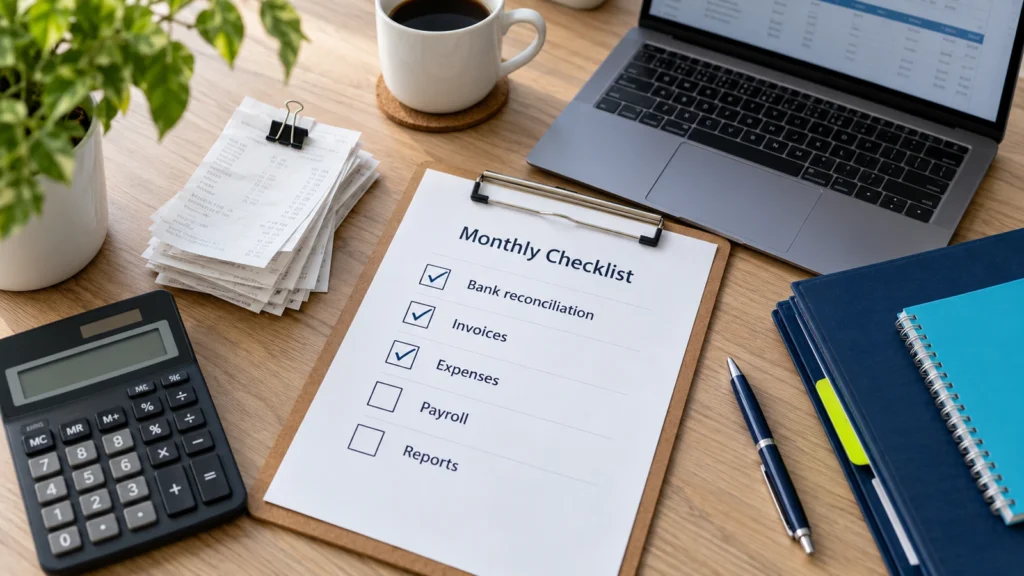
Keeping your accounts up to date should not be something you only think about at GST time or at the end of the financial year. We find that the businesses with the clearest understanding of their financial position are usually the ones that follow a simple, consistent monthly accounting checklist.
A good month-end process helps you confirm that your numbers are accurate, identify unpaid invoices, understand what you owe, prepare for tax obligations and see how the business is actually performing.
It does not need to become a complicated accounting exercise. For many New Zealand small businesses, the goal is simply to close each month knowing that the accounting records reflect what has genuinely happened in the business.
This guide provides general information. Your accounting and tax requirements will depend on your business structure, GST status, employees, accounting method and individual circumstances.
Quick answer
Our monthly accounting checklist for a New Zealand small business is:
- Reconcile all bank and credit card accounts.
- Check outstanding customer invoices.
- Review supplier bills and upcoming payments.
- Confirm payroll and employee records are correct.
- Review GST and other upcoming tax obligations.
- Check expenses have been coded correctly.
- Review assets, loans, drawings and other balance sheet accounts.
- Run your Profit and Loss and Balance Sheet reports.
- Compare actual performance against your budget or previous months.
- Update your short-term cash flow forecast.
- Resolve unusual transactions or unexplained balances.
- Close or lock the month once you are satisfied the records are correct.
The purpose of a monthly accounting checklist is not simply to make the bookkeeping tidy. It is to give you dependable information that you can use to run the business.
IRD also requires businesses to retain appropriate tax records. As at 3 September 2026, IRD says records of cash and electronic sales, expenses and other relevant business information generally need to be kept for at least seven tax years.
What this means for a New Zealand business
Your accounting software can contain thousands of transactions and still give you misleading information if those transactions have not been checked properly.
For example, suppose your Profit and Loss report shows that your business made a $25,000 profit during the month.
That sounds encouraging.
But imagine that:
- $18,000 of overdue invoices has not been collected
- two large supplier invoices have not been entered
- a loan repayment has been coded entirely as an expense
- several personal expenses have been included as business costs
- GST transactions have been coded incorrectly.
Your accounting software may be producing a report, but that does not automatically mean the report is accurate enough to make decisions from.
That is why we see the month end close as a quality-control process.
Each month you are effectively asking:
Do my accounting records match what actually happened in the business?
Once the answer is yes, your financial reports become much more useful.
They can help you decide whether you can afford another employee, whether your margins are improving, whether customers are paying quickly enough, whether costs are getting out of control and whether you have enough cash available for upcoming tax payments.
For a broader explanation of where bookkeeping stops and accounting begins, read our guide to bookkeeping vs accounting in New Zealand.
How it works step by step
1. Reconcile your bank accounts
Start by reconciling every business bank account.
The balance shown in your accounting software should agree with the actual bank balance after allowing for legitimate timing differences.
We would also reconcile:
- business credit cards
- loan accounts
- payment platforms
- merchant accounts
- petty cash
- any clearing accounts used by your accounting system.
Unreconciled transactions are one of the fastest ways for accounting records to become unreliable.
2. Check your accounts receivable
Run an aged receivables report and look at who owes you money.
Ask:
- Are all completed jobs or sales invoiced?
- Are any invoices overdue?
- Are customers regularly paying late?
- Are there old balances that need investigating?
- Are any amounts potentially uncollectable?
Do not simply look at total sales. Cash sitting in your customers’ bank accounts does not help you pay wages, GST or suppliers.
3. Review accounts payable
Next, check the money you owe suppliers.
Make sure bills received during the month have been entered and coded correctly.
Reviewing your payables also gives you a clearer picture of your upcoming cash commitments.
4. Check payroll
If you employ staff, confirm that payroll transactions, PAYE, KiwiSaver deductions, leave and other payroll-related amounts have been processed correctly.
As at 3 September 2026, employers filing electronically generally need to provide employment information to IRD within two working days of each payday.
Employment New Zealand also requires employers to maintain complete and accurate wage, time, holiday and leave records. These records generally need to be retained for six years.
Your monthly review is a good opportunity to identify discrepancies before they continue for several pay periods.
5. Review GST
If you are GST registered, check that sales and purchases have been given the correct GST treatment.
Look particularly carefully at unusual transactions, asset purchases, private-use expenses and transactions where the GST treatment is not obvious.
As at 3 September 2026, the standard New Zealand GST rate is 15%. GST returns are generally due on the 28th of the month following the end of the taxable period, with specific exceptions for periods ending 31 March and 30 November.
Your exact filing frequency and accounting basis will affect how you prepare your GST return.
6. Review transaction coding
Scan your Profit and Loss report for anything unusual.
A sudden spike in motor vehicle costs, software expenses or professional fees may be perfectly legitimate. It may also indicate that something has been coded incorrectly.
We find that month-on-month comparisons make errors much easier to identify.
7. Check balance sheet accounts
Do not focus only on profit.
Review:
- bank balances
- debtors
- creditors
- loans
- GST
- PAYE
- shareholder current accounts
- fixed assets
- finance agreements
- other assets and liabilities.
Old or unexplained balances should be investigated rather than allowed to accumulate.
8. Review your financial reports
Once your accounts have been reconciled, run your:
- Profit and Loss report
- Balance Sheet
- aged receivables
- aged payables
- cash flow report or forecast.
At this point, the conversation changes from bookkeeping to business management.
You can start asking why revenue changed, why margins moved, which expenses increased and what needs attention next month.
Calculations, records or decisions involved
A useful monthly bookkeeping checklist should leave you with enough information to answer some basic financial questions.
Revenue
Compare monthly revenue with:
- the previous month
- the same month last year
- your budget or forecast.
Look for trends rather than reacting to one isolated figure.
Gross profit and margins
If revenue is rising but profit is not, investigate whether labour, product, freight or other direct costs have increased.
A percentage comparison can often tell you more than the dollar value alone.
Operating expenses
Review your major expense categories.
Small increases across multiple subscriptions, contractors or overheads can add up to a meaningful reduction in profit.
Cash position
Your accounting profit and your available cash are not the same thing.
A profitable business can still experience cash flow problems if customers pay slowly, stock levels increase, debt repayments are high or tax payments fall due.
Receivable days
If customers are increasingly slow to pay, you may need to review invoicing, credit terms or debt collection.
Tax provisions
We recommend treating GST, PAYE and income tax as genuine liabilities rather than available operating cash.
Setting money aside progressively can reduce the pressure when payment dates arrive.
Accurate records support these calculations. IRD says tax records may include invoices, receipts, bank statements, credit card records, sales records and information about assets and liabilities.
Common mistakes and risks
One of the most common mistakes we see is assuming that bank feeds mean the bookkeeping has effectively been completed.
Bank feeds save time. They do not replace review.
Other common problems include:
- reconciling transactions without checking the coding
- mixing personal and business spending
- failing to enter supplier bills
- leaving customer invoices overdue for months
- incorrectly coding loan repayments
- treating asset purchases as ordinary expenses
- ignoring old balances on the Balance Sheet
- reviewing reports before reconciliation is complete
- forgetting upcoming GST or PAYE obligations
- failing to retain supporting documents
- allowing previous accounting periods to be changed after reporting is complete.
Another risk is waiting until the end of the financial year before correcting everything.
Twelve months of small errors can turn into a substantial clean-up job.
A consistent monthly process makes problems easier to identify while the transactions are still recent.
Practical checklist
We recommend using the following monthly accounting checklist every month.
Bank and transactions
- Reconcile every bank account
- Reconcile business credit cards
- Check payment gateways and merchant accounts
- Resolve duplicate and unreconciled transactions
- Attach invoices and receipts where appropriate
- Check expenses have been coded correctly.
Customers
- Confirm all sales have been invoiced
- Review aged receivables
- Follow up overdue invoices
- Investigate old customer balances.
Suppliers
- Enter outstanding supplier bills
- Review aged payables
- Check upcoming supplier payments
- Confirm large or unusual expenses.
Payroll and tax
- Check payroll transactions
- Review PAYE and KiwiSaver liabilities where applicable
- Check leave balances and payroll records
- Review GST coding
- Confirm upcoming IRD filing and payment dates
- Update tax provisions where appropriate.
Financial position
- Review loans and finance accounts
- Check shareholder drawings or current accounts where relevant
- Record significant asset purchases or disposals correctly
- Review the Balance Sheet for unexpected balances.
Management review
- Run the Profit and Loss report
- Compare results with budget
- Compare with previous months
- Review gross margin
- Check major expense movements
- Review cash available
- Update the next 30 to 90 days of cash flow
- Identify actions for the coming month.
Once the accounts are complete, consider locking the accounting period so transactions cannot be accidentally changed later.
If you are deciding how much of this process to manage internally, our guide to small business accountant costs in New Zealand explains what typically affects accounting fees.
When to speak with an accountant or business adviser
You do not necessarily need an accountant to perform every step of your monthly bookkeeping.
You should, however, understand what your reports are telling you.
We would suggest getting professional advice when:
- your Balance Sheet contains balances you cannot explain
- your accounting records are consistently behind
- GST coding is unclear
- you are unsure whether expenses are deductible
- payroll liabilities do not reconcile
- your cash balance is declining despite reported profits
- your margins are deteriorating
- tax obligations are becoming difficult to forecast
- you are buying significant assets or taking on debt
- your business is growing quickly
- you need better management reporting
- you are making a major financial or structural decision.
The value of maintaining good small business accounts is not simply having tidy records for your accountant at year end.
The real benefit is having accurate information throughout the year.
When we can look at reliable monthly accounts, we can identify problems earlier, make decisions with more confidence and understand what needs to happen next.
If you need help improving your bookkeeping processes, financial reporting or accounting systems, learn more about our Accounting Expertise services.
For advice based on your individual circumstances, you can also contact Humphries Associates.
Frequently asked questions
What is the short answer for a New Zealand business?
Complete your bookkeeping every month rather than waiting until GST or year end. Reconcile your accounts, review customers and suppliers, check payroll and tax obligations, review your Profit and Loss and Balance Sheet, then update your cash flow forecast.
What records or information will I need?
You will normally need bank and credit card records, customer invoices, supplier bills, receipts, payroll information, loan statements and supporting information for assets and unusual transactions. As at 3 September 2026, IRD generally requires relevant tax records to be retained for at least seven tax years.
What are the most common mistakes?
Common mistakes include unreconciled transactions, incorrect coding, missing invoices, mixing personal and business spending, ignoring overdue debtors and relying on financial reports before the bookkeeping has been properly reviewed.
When should I get professional advice?
Speak with an accountant or business adviser when you cannot explain balances in your accounts, have uncertainty about GST or tax treatment, experience cash flow pressure, need management reporting or are making decisions that could materially affect the financial position of the business.
General information notice: This article provides general information for New Zealand business owners. Accounting, tax and financial decisions should be considered in light of your individual circumstances and current legislation or IRD guidance.