

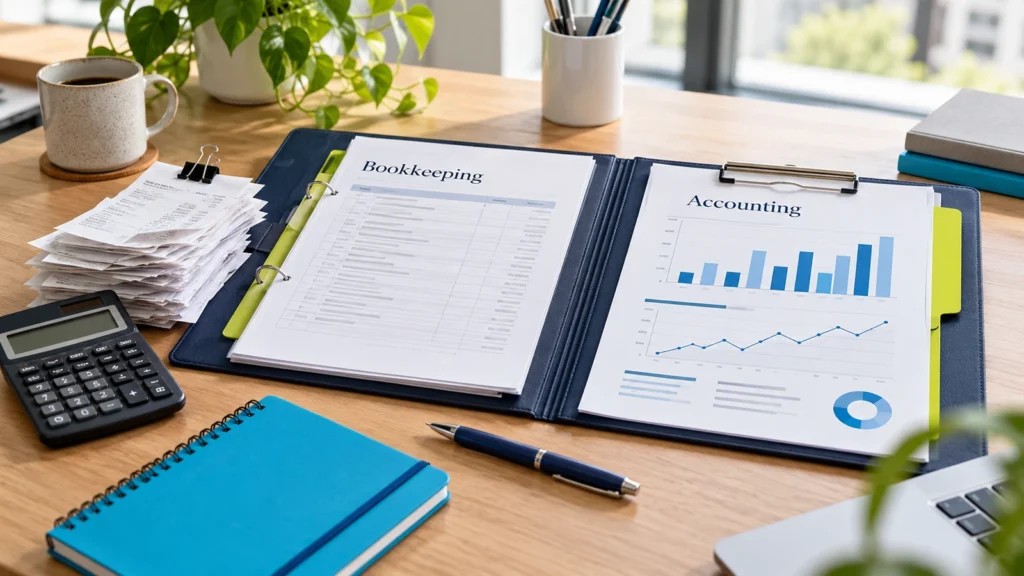
If you are trying to decide between a bookkeeper or accountant, the answer is often that your business needs both, but for different reasons.
We think of bookkeeping as the process that keeps your financial information accurate and up to date. Accounting takes that information further by checking it, interpreting it, meeting tax and reporting obligations, and helping you make better financial decisions.
For many New Zealand businesses, the most efficient arrangement is therefore not bookkeeping versus accounting. It is good bookkeeping feeding reliable information into good accounting.
At Humphries Associates, this distinction matters because the quality of the decisions we can help a business owner make depends heavily on the quality of the financial information available to us. Our Knowledge Hub follows an answer-first structure, with practical New Zealand examples, primary sources and clear connections between guides and relevant services.
Quick answer
A bookkeeper generally looks after the day-to-day financial records of your business. An accountant generally uses those records to prepare accounts, manage tax and compliance, analyse performance and advise you on financial decisions.
If your main problem is keeping invoices, expenses, bank transactions and reconciliations up to date, bookkeeping may be what you need.
If you need help understanding profitability, preparing financial statements, dealing with tax, correcting accounting problems, planning ahead or making significant business decisions, we would generally look towards an accountant.
Business.govt.nz similarly notes that a bookkeeper can be a suitable option for day-to-day finances, while regular accountant input becomes particularly valuable around tax, growth, investment, borrowing and other significant financial decisions.
Here is the distinction we would use:
| Bookkeeping | Accounting |
| Recording transactions | Reviewing and interpreting records |
| Bank reconciliation | Financial statement preparation |
| Processing invoices | Tax compliance and planning |
| Accounts payable and receivable | Identifying financial risks |
| Maintaining accounting software | Analysing profitability and performance |
| Keeping records organised | Advising on business decisions |
| Routine financial processing | Dealing with more complex IRD matters |
| Supporting payroll processes | Strategic financial guidance |
The line is not always rigid. Some bookkeeping providers offer broader services, while some accounting firms manage both the processing and advisory sides of the business.
What this means for a New Zealand business
The easiest way to understand bookkeeping vs accounting in NZ is to look at the financial information journey.
Imagine you run an Auckland building company.
Throughout the month you might have supplier invoices, subcontractor payments, customer deposits, vehicle expenses, equipment purchases, wages and dozens or hundreds of bank transactions.
Someone needs to make sure those transactions are captured correctly. That is the bookkeeping side.
But you may also want to know:
- Are our margins improving or declining?
- Are particular jobs actually profitable?
- How much tax should we be preparing for?
- Can we afford another employee?
- Is cash flow strong enough to purchase another vehicle?
- Why has revenue increased but the bank balance has not?
- Are we treating large equipment purchases correctly?
- What do our accounts tell us about the next six months?
That is where accounting starts to become much more important.
Good small business bookkeeping in NZ gives us the raw financial information. Good accounting turns that information into something you can use.
There is also a compliance reason to get the foundation right. As at 3 September 2026, Inland Revenue states that businesses should keep records of cash and non-cash sales and expenses and retain their records, including electronic records, for at least seven tax years.
IRD also identifies records such as invoices, receipts, bank statements, credit card records and cashbook information as part of the records businesses may need.
How it works step by step
In practice, we would divide the process into four layers.
1. Transactions happen
Your business earns income and incurs expenses.
You send invoices, receive customer payments, pay suppliers, purchase assets, reimburse expenses and possibly pay employees.
These transactions create your financial history.
2. Bookkeeping organises the information
Your bookkeeping system records and categorises those transactions.
That can include:
- reconciling bank accounts
- entering and processing invoices
- recording expenses
- allocating transactions to appropriate accounts
- tracking money owed by customers
- tracking supplier bills
- maintaining supporting documents
- keeping Xero, MYOB or another accounting platform current
Automation can make this much easier, but we would not assume software removes the need for oversight.
A bank feed can import a transaction. It cannot always determine the correct accounting or tax treatment of that transaction.
3. Accounting checks and interprets the information
This is where we move beyond simply asking, “Did we record the transaction?”
We start asking, “What does it mean?”
An accountant may review the information for inconsistencies, make accounting adjustments, prepare financial statements, calculate tax positions and identify issues requiring further investigation.
The accountant can then analyse areas such as revenue, gross profit, overheads, cash flow, debtors, liabilities and business performance.
4. The numbers support decisions
This is the part we believe business owners sometimes underestimate.
Accurate accounting should not exist purely to produce a tax return.
It should help you make decisions.
For example, if sales increase from $800,000 to $1 million, that looks positive. But if margins fall, wages rise substantially and customers are taking longer to pay, the additional turnover may not translate into better cash flow or profit.
Bookkeeping records what happened.
Accounting helps explain why it happened and what you might do next.
That is also why our Accounting Expertise service includes accounting system management, cloud accounting, financial reporting, tax-related work and help resolving accounting problems rather than treating accounting as a once-a-year exercise.
Calculations, records or decisions involved
Before deciding whether you need bookkeeping, accounting or both, we would look at three areas.
How much financial processing is involved?
A consultant with 30 transactions per month has very different bookkeeping requirements from a retailer processing hundreds of sales, supplier invoices and payroll transactions.
As transaction volume grows, consistent bookkeeping becomes increasingly important.
How complicated is the business?
Complexity matters just as much as size.
A small business might still require significant accounting input if it:
- employs staff
- is GST registered
- owns significant assets
- has loans or shareholder accounts
- operates through multiple entities
- has several income streams
- is experiencing rapid growth
- is preparing for investment or finance
- has unusual tax issues
What decisions are you trying to make?
If you simply need somebody to keep the accounts up to date, bookkeeping may be sufficient for the immediate task.
If you are asking whether you can afford to expand, whether margins are adequate, why cash flow is deteriorating or how a business decision may affect your tax position, we would involve an accountant.
And if you are choosing an accountant specifically, professional credentials can also matter. CA ANZ’s current pathway to the Chartered Accountant designation includes academic requirements, the Graduate Diploma of Chartered Accounting and three years of structured mentored practical experience. Members are also subject to professional and ethical standards.
Common mistakes and risks
One of the biggest mistakes we see is treating bookkeeping and accounting as interchangeable.
They overlap, but they solve different problems.
Another common mistake is waiting until the end of the financial year before checking whether the underlying records are reliable.
If transactions have been miscoded for 12 months, bank accounts have not been reconciled and supporting documents are missing, your accountant may first have to clean everything up before meaningful accounting work can begin.
Other risks include:
- mixing personal and business spending
- incorrectly categorising expenses
- failing to reconcile accounts regularly
- duplicating transactions
- missing invoices or receipts
- relying too heavily on automatic transaction coding
- failing to review outstanding debtors
- assuming accounting software automatically guarantees compliance
- only looking at the bank balance when assessing business performance
- engaging professional accounting help only after a problem has developed
Practical checklist
When a business owner asks us whether they need a bookkeeper or accountant, we would work through the following checklist.
Consider a bookkeeper if:
- your transactions are falling behind
- bank reconciliations are not being completed
- invoices and receipts are becoming disorganised
- you are spending too much time entering transactions
- accounts payable or receivable need closer management
- your accounting software needs regular processing
- your accountant is receiving incomplete or messy information
Consider an accountant if:
- you need financial statements or tax returns prepared
- you are unsure whether transactions have been treated correctly
- you want tax planning or compliance guidance
- your business is growing quickly
- profitability or cash flow is unclear
- you are taking on significant debt
- you are buying assets or another business
- you are considering restructuring
- you are dealing with an IRD issue
- you need better financial reporting
- you want financial information to support business decisions
Consider both if:
- your business has regular transaction volume and increasingly complex financial decisions
- you want accurate monthly records plus periodic financial analysis
- you want your accountant working from clean, current information rather than reconstructing the books at year end
A useful related guide is How Much Does a Small Business Accountant Cost in New Zealand?, which will help business owners compare the cost of professional support against the level and complexity of accounting work required.
When to speak with an accountant or business adviser
We would not wait until there is a tax problem before talking to an accountant.
Professional input can be particularly valuable when something important is changing in your business.
That could include starting a business, hiring staff, experiencing rapid growth, having difficulty paying bills, seeking finance, buying another business, preparing for investment or considering selling.
Business.govt.nz specifically recommends seeking financial advice around circumstances such as starting out, cash flow difficulties, growth, major loans, investment, selling a business and complicated tax matters.
You also do not necessarily need to outsource everything.
A practical model may be to keep straightforward bookkeeping internally, outsource more complicated processing and have your accountant periodically review the accounts.
Another business may prefer its accounting provider to manage most of the process.
The right arrangement depends on your transaction volume, internal skills, business complexity and what you need from your financial information.
If you want to work out what level of support makes sense for your business, you can contact Humphries Associates to discuss your existing accounting process and where the gaps may be.
The important point is not to buy more accounting support than you need. It is to make sure the financial information you are relying on is accurate enough, current enough and useful enough for the decisions you are making.
Frequently asked questions
What is the short answer for a New Zealand business?
A bookkeeper generally manages your day-to-day financial records, while an accountant reviews and interprets those records, prepares accounts, deals with tax and compliance matters, and can provide financial advice. Many established businesses benefit from using both.
What records or information will I need?
You may need bank statements, invoices, receipts, credit card records, sales information, expense records, payroll information, loan documents and details of assets and liabilities. As at September 2026, IRD generally requires business tax records to be retained for at least seven tax years.
What are the most common mistakes?
Common problems include poor reconciliation, incorrect transaction coding, missing supporting documents, mixing personal and business expenses, relying too heavily on accounting software automation and waiting until year end to discover that the underlying records are inaccurate.
When should I get professional advice?
We would consider professional accounting advice when your business becomes more complex, you are making a significant financial decision, you are experiencing tax or cash flow problems, you are growing quickly, or you no longer feel confident that your accounts accurately reflect what is happening in the business.
This article provides general information for New Zealand business owners. Accounting, tax and financial decisions should be considered in light of your individual circumstances. Rules and requirements can change, so current guidance should be checked before acting.